All new drug applications filed with the United States Food and Drug Administration (FDA) include data from animal developmental and reproductive-toxicologic studies. Although major new teratogenic drugs in humans have been predicted from animal studies, there are problems in extrapolating animal data to humans. Animals have a different "gestational clock" to humans, there is marked interspecies variability in susceptibility to teratogens and no experimental animal is metabolically and physiologically identical to humans. Animal studies are important because, in some instances, they have shed light on mechanisms of teratogenicity and because when an agent causes similar patterns of anomalies in several species, human teratogenesis should also be suspected. Teratogens act with specificity in that they produce specific abnormalities at specific times during gestation. For example, thalidomide produces limb phocomelia, while valproic acid and carbamazepine produce neural tube defects. Other teratogens are associated with recognizable patterns of malformations, for example, phenytoin with foetal hydantoin syndrome and coumarin anticoagulants with foetal warfarin syndrome (see proven teratogenic drugs in humans for description of the above). Teratogenic specificity also applies to species, for example, aspirin and corticosteroids have been found to be teratogenic in mice and rats but appear to be safe in humans.Thalidomide, on the other hand, was not shown to be teratogenic in rats, a tragic fact that resulted in significant human morbidity.[18] Teratogens may demonstrate a dose-effect relationship. At low doses there can be no effect, at intermediate doses the characteristic pattern of malformations will result, and at high dose the embryo will be killed. A dose-response may be considered essential in establishing teratogenicity in animals, but is uncommonly demonstrated in sufficient data among humans. A threshold dose is the dosage below which the incidence of adverse effects is not statistically greater than that of controls. With most agents, a dose threshold for teratogenic effects has not been determined; however they are usually well below levels required to cause toxicity in adults. Teratogens must reach the developing conceptus in sufficient amounts to cause their effects. Large molecules with molecular weights greater than 1,000 do not easily cross the placenta into the embryonic-foetal bloodstream to exert potential teratogenic effect. Other factors influencing the rate and extent of placental transfer of xenobiotics include polarity, lipid solubility and the existence of a specific protein carrier. Understanding the mechanisms of the induction of birth defects is key to determine how to prevent these effects. Further, increasing the accuracy of experimental animal extrapolation will aid in the interpretation of experimental data in order to more accurately determine the risk of a given compound to elicit birth defects in humans.[17] |
When one considers the many physiological and biochemical differences between animal species used in teratology research and humans, it is of no great surprise that no one species can be shown to be the experimental ‘animal of choice. No one species absorbs, metabolises and eliminates test substances just like a human nor possesses the same placental transfer properties; no one species has the same pre-term developmental and metabolic patterns as do humans. Despite these liabilities, rodents have become the most commonly used species for evaluating potential human teratogens. It is commonly recommended that drugs should be examined for teratogenic activity in two species of animal: in most cases the species used are the rat or mouse, and the rabbit. The miniature pig and the monkey might well figure more prominently in the future Although the chick embryo has been used extensively in embryological work, it is not considered to be suitable for the routine screening of drugs for teratogenicity.[16] .jpg) 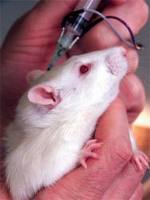 The two widely used animals for clinical testing of teratogenicity of various drugs and medications; Rabbit (top) and mice (left). |
